A Common Silence - part 2 of 5

I must desensitize myself to a horror in order to examine it as a fabric of historical and cultural threads. I can cut the fabric up and reassemble it. I can mix the metaphors until one of them catches on your sleeve. While brushing it off, you might notice a sparkling thread and have a closer look. That is my aim.
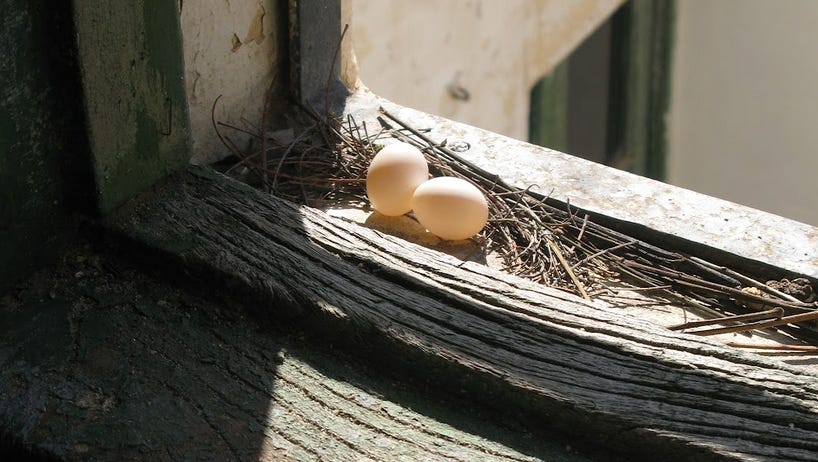
I also don’t want to desensitize to / from the ongoing horror. Perhaps that’s what I chose when I chose to live. To live in a world of solitary confinement and endless war and inexpressible beauty. Not to keep everything separate. My tools are language and an occasional image that stands in for a poem — those urban eggs on a window ledge in a former US-approved detention camp in Argentina, now a place of memory. The female had just flown off. I have to interrupt my own flow, do my best to avoid condescension towards my historical subjects, architects of those horrors, tempting as that might be.
It was a group of Quakers in Pennsylvania in the 1780s, appalled by whippings they witnessed in detention centers, who proposed that the new nation punish people by removing them from all but official human contact and giving them time to reflect on their sins. The Philadelphia Society for Alleviating the Miseries of Public Prisons viewed solitary confinement as an improvement over forms of corporal punishment such as lashing the body, pouring boiling oil over it, or ripping it to pieces. These were approaches to addressing deviance, as defined by groups with power, that the Quakers knew. Convicted people who followed the rules would earn the privilege and comfort of a Bible. After a period of moral recalibration they would return, penitent (re-educated / rehabilitated / reformed) to society. That was the theory, at least, of the penitentiary model in the US.
To trace some of the genealogical threads of solitary confinement:
In its genetic material, religious, specifically Christian. Which provides an important context for the Democratic sheriff of the jail where I was teaching in the second decade of the twenty-first century (and noticing the established culture of guards putting people in solitary confinement for what appeared to be minor infractions, like bringing a green pepper back to your cell from the kitchen), saying without apology or a hint of self-consciousness, at a public event, This is a Christian jail. A comment that was not followed by any gasps of disbelief. We understood.
Born of a culture of detention. The first public building of the new colonies / settlements wrestled from Native nations in North America in the 17th and early 18th centuries was often a jail, to process people shipped unwillingly from Europe into indentured servitude and enslaved people shipped from the Caribbean or West Africa. There is a symbolism to the first structure erected by a community. And certainly a challenge for a new nation — whose economic foundation and force was built with the labor of people processed by those jails — to subvert those origins.
The unquestioned assumption that depriving human beings — an unforgivingly social species among mammals, think of how long our young are fully dependent on others for survival vs. a colt that can run several hours after birth — depriving a human being of human contact could somehow improve your behavior, or at least make you more obedient.
And an earlier assumption that punishment can correct or deter deviance, again, defined by those in power (legislators, doctors, educators) — that one activity can produce a particular outcome.
That the production of deviance — how this happens — joins other forms of the state’s exertion of power that by necessity must be hidden.
What if deviance (or rather, whatever actions could end you up in a cage) is being non-white, property-less, low-income, on the spectrum, excluded from school (a “drop out”), multi-gendered, living with disability, having a history of trauma and consequent mental health issues, being a graduate of the foster care system, struggling with addiction. Because there you have a description of most of the people currently living in our county jail system, including a majority of residents who have not yet been convicted of a crime, commonly referred to as “pre-trial detainees.” To say nothing of the human beings now processed by quickly erected processing / detention / deportation centers such as Fort Bliss, previously used as a concentration camp for thousands of Japanese Americans during World War II. We didn’t arrive here yesterday or the day before.
The Quakers . . . viewed solitary confinement as an improvement over forms of corporal punishment such as lashing the body, pouring boiling oil over it, or ripping it to pieces.
In practice, because the Quakers hadn’t tested out on themselves what it would be like to sit in an eight by ten foot cage for a day or a year or four decades, the results didn’t align with the theory of solitary confinement. French traveler François duc de Rochefoucauld Liancourt published a pamphlet about the Walnut Street Prison in Philadelphia after visiting in 1795, reporting that residents “see the turnkey but once a day, to receive a small pudding of Indian corn, together with some malasess.” The duke was not impressed by preliminary data, which he described as high rates of madness and suicide.
Possibly to address those outcomes and also to make the prisons pay for themselves, wardens in the early penitentiaries in the US added work to the daily regimen of reflection. You contributed your unpaid labor not only to the construction and ongoing maintenance of prisons, but also external contracts — like prison industries today, and convict leasing and penal colonies yesterday. Soon the sounds of weavers, joiners, carpenters, shoemakers, and tailors, mostly immigrants, filled the penitentiaries.
Gustave and Alexis were not the first French aristocrats to visit US prisons. After the French Revolution and for subsequent decades of social and political unrest, old and new elites (nobility / bankers / resource extractors / manufacturers / traders) must have wondered how best to control groups they found threatening, elbowing their way into the halls of power. Well-financed adventurers traveled to New York and Philadelphia to see for themselves, among other things, the bold architecture of the young nation’s most expensive public buildings (prisons) and the modern reforms taking place there.
The stated goal of prison reform is usually to find a more humane (or rather, efficient) approach to punishment than current practices. The guillotine was more humane, because more efficient, than the ax. These days some consider the sentence of life in prison without the possibility of parole an improvement over death by electrocution, lethal injection, nitrogen gas, or firing squad. Others call life without parole death by incarceration. Contemporary supporters of solitary confinement, especially in the supermax prisons where everyone is locked in a cage 22-23 hours per day, point to the efficiencies: fewer guards necessary, cost of labor savings, safety ensured, control maintained.
Well-financed adventurers traveled to New York and Philadelphia to see for themselves, among other things, the bold architecture of the young nation’s most expensive public buildings (prisons) and the modern reforms taking place there.
In the Auburn (New York) system, solitary nights were followed by labor during the day with other detainees. Silence was observed by all but the overseers, who punished even humming with the whip. In the Pennsylvania system, where guards kept prisoners apart through the day and night, unskilled workers sawed and polished marble, cut logs, card wool, and beat hemp. Weaker and less skilled workers were assigned to picking wool, hair, and oakum. (Picking wool: the first stage of making yarn, in which you remove the debris and loosen the wool. Picking animal hair: for brushes and upholstery stuffing and even shirt collars. Picking oakum: pulling apart old ropes made of hemp or jute and rolling them into lengths to be dipped in tar and used to caulk ships.)
So incarcerated labor contributed to a broad swathe of the economy in 1831, from textiles to transport, the prison system and the labor market entwined. Long before the assembly line, from the 18th century the factory system (think of damming the mighty rivers to produce water power; steam engines; textiles) required workers to perform tedious, repetitive tasks, often without speaking.
Labor as punishment, laborer as animate machine, inanimate machine, obsolete machine, semi-human, three fifths human, replaceable, automated, displaced by AI.
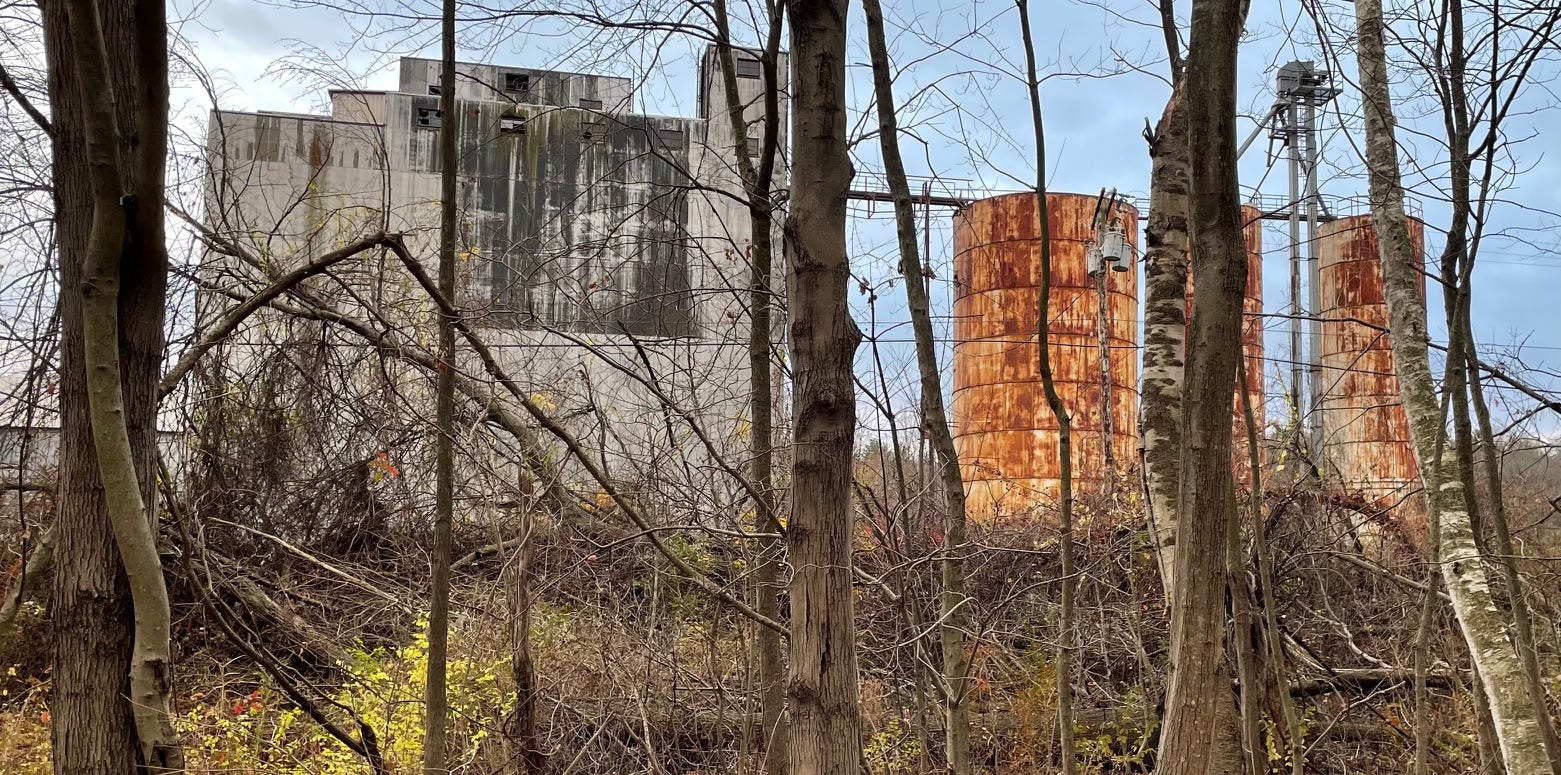
Like a dream on waking, the continuing efforts to dismantle — de-school, un-learn, de-colonize — the effects of the best indoctrination into the superiority of whiteness and European cultural practices. Forgetting at the moment of awareness. So that I may live more fully at the end, assemble words that don’t disguise the violence, I look back and let go.
Of not having a single non-white instructor during my education in the 1980s and 90s, only three white women, one out queer. Of learning nothing in the elite high school I attended about the period of Reconstruction after the US civil war and the subsequent years of state terror and dispossession as white supremacy reasserted itself. Of not absorbing anything until after college about the civil rights movements in the US, black veterans of World War II returning from the fight against fascism abroad, only to find it still entrenched at home. Of growing up during the women’s and queer rights movements and having no awareness they were relevant to my life until I reached my thirties — not having the benefit of that analysis to contextualize my own experiences, emotions, and those of my mother’s and grandmothers’ generations. Of laboring for decades in corporate institutions including higher education and a county jail. Sitting for tens of thousands of hours. Living with chronic pain for twenty-five years.
This is all relevant to my investigations into the genealogy of what is referred to hygienically as solitary confinement because so much was and is still invisible to me: how power operates, the interconnections of our practices and bodies, how this physical organism comes to a provisional understanding of its place on Earth, the traces of human lives that live on in it, despite its ignorance, the building of new connections and formations that are not oppressive to some group of humans or poisonous to other species.
To defend preemptively the often awkward arrangement of words first heard in that chattering silence of the non-self: of course the language is compressed, multi-tonal, multi-gendered, body-bound, almost a hundred years after Virginia Woolf’s A Room of One’s Own and what she calls male and female sentences, as I attend to the voices each clamoring to be heard. It’s not just a history I am trying to create.
I wonder what new genders of sentence will mimic the winding slow effort to uncover and convey this whole being, not just consciousness, memory, desire, the biome of the intestines, living through climate breakdown and its acceleration by technology and endless war, the safety nets that once mollified revolts against capitalism now being rapidly dismantled, accelerating the collapse, and the potential for that being to connect with others. All the historical parallels. In Four Lost Cities Annalee Newitz brilliantly explores contemporary archaeology and the excavation of great cities / civilizations that have ended with a confluence of social and political unrest and climatic catastrophe. Others have experienced what we are experiencing, we need only seek them out and listen, attend to their lessons. We are not exceptional.
Letting go of all the obstacles, such as how can I continue writing when someone is holding her child in her arms, large-eyed from hunger and war. When there are two high schools at Riker’s Island jail (incarcerated population 7,000), built from landfill ashes by incarcerated people. When rivers are drying up and microplastics fill our blood. To walk in the woods, to read, think, write, make connections as the drones strike elsewhere, for now.
Letting go of all the obstacles, the nonstop violence. Grasping the moment just before forgetting I can let go. Dwelling there, after the exhalation.
In preparation for their study of prisons in the US, Alexis and Gustave read all the secondary material available to them in Paris. They discussed Rochefoucauld Liancourt’s perspectives on Walnut Street Prison and the accounts of François-René de Chateaubriand of his travels in the US. (Chateaubriand was an uncle of Alexis. His father, René de Chateaubriand, was a seaman turned slave trader.) James Fenimore Cooper’s hugely popular Leatherstocking Tales filled their dreams with “noble savages,” a trope / meme that arose during a historical period when settler colonists were accelerating the ██████ displacement and depopulation of native peoples through disease and murder.
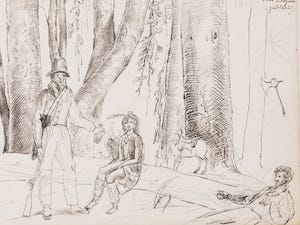
The young explorers took detours from their official prison-hopping itinerary to catch sight of Indians — and didn’t always like what they saw. At the port of Memphis, they witnessed members of the Choctaw nation being ushered onto a barge in a federal action known as Indian Removals, later the Trail of Tears. People were forced to walk from lands their ancestors had stewarded for millenia in present-day Mississippi to Arkansas and later Oklahoma. In a letter to his mother, Alexis wrote:
Finally the elderly were led aboard. Among them was a woman aged 110. I have never seen a more terrifying figure. She was naked except for a blanket through which one could glimpse the most emaciated body. She was escorted by two or three generations.
In his letters and journals Alexis wrote racialized descriptions of indigenous people in degraded physical conditions drinking alcohol — typical of his times. Which makes all the more interesting his reflections on colonized thinking, including his own. After repeating the tiresome and contradictory memes of filth, laziness, addiction, and a vanishing and noble race, Alexis in this journal entry shifts his attention to the settler colonists.
An ancient people, the first and legitimate master of the American continent, is vanishing daily like the snow in sunshine. . . . In its place another race is increasing at a rate that is even more astonishing. It fells the forests and drains the marshes; lakes as large as seas and huge rivers resist its triumphant march in vain. The wilds become villages, and the villages towns. The American, the daily witness of such wonders, does not see anything astonishing in all this. This incredible destruction, this even more surprising growth, seem to him the usual progress of things in this world. He gets accustomed to it as the unalterable order of nature. [emphasis added]
“One might say,” Alexis reflected on July 4, 1831, “that the European is to the other races of man what man in general is to the rest of animate nature. When he cannot bend them to his use or make them indirectly serve his well-being, he destroys them.”
In liberty and freedom as the Europeans defined it — rather than, say, as the sachems of the Six Nations of the Haudenosaunee Confederacy did — license and the stomach to devour a land mass. In the European Enlightenment ideas of individual freedom, progress, and development on which so many generations were fed, including my own, environmental destruction and cultural erasure.
Many of the foundational assumptions of my upbringing and education — that progress moves forward, that truth exists, that development is sustainable, that personal freedom can only expand in the US system of government, that there is a shared language of science and human rights among citizens of the world, a right and a wrong, neatly separated — now feel out of touch, even dangerous. They distract me from the realities that extinction is already here, that we are not living within a rule of law. They also interfere like so much static with the collective human project now happening to develop structures — of living, loving, raising children, growing food, meeting basic needs, dealing with waste — that aren’t oppressive and protect the Earth from further damage by our species.
The absence of freedom at the moment of conception of a nation founded on liberty I oppose with the compulsion of a storyteller born of US violence to follow this imperial settler colony to its logical anti-human and Earth-hating conclusion. To mess with that. To include in a reflection on solitary confinement the endless dirty wars to protect our freedoms. These are not tangents but essential parts of the history.
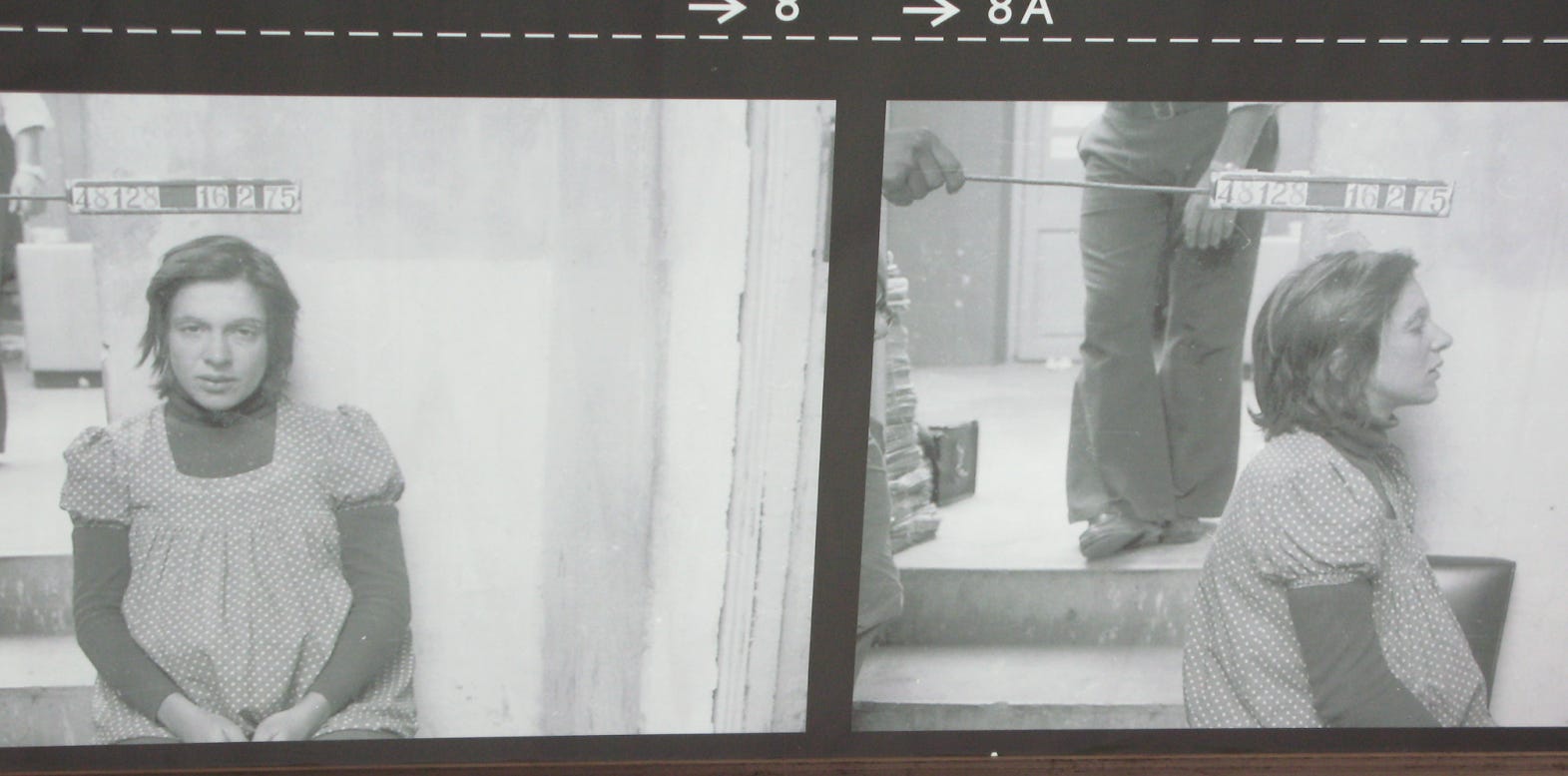
In Argentina in the 1970s, for example, following anti-communist policies sanctioned by the US, personnel tortured students at La Perla (The Pearl) using enhanced interrogation techniques — a terrible euphemism used to disguise sexual torture and state terror. I will return to La Perla, where I had an encounter in 2013 that changed my orientation in the world, in a future installment, maybe the next one if you are interested.
Imagine the whole body of the relaxed guard in the background and another holding a number just above the head of the young person being booked. She appears to be pregnant. I place the face of this young human — most likely an idealistic student, a socialist, a union member, opposing authoritarian rule and the disappearance of her beloveds, but possibly not, she could just have been snatched off the street, walking home from the market with ingredients for dinner — alongside Alexis’s trope / meme of Indians vanishing like snow in the sunshine.
People don’t vanish or disappear like snow in sunshine except in tales of Last Indians. Power is hidden in its bunker, proclaiming its protection of our freedoms, whipping up hatred of the Other. Adults kidnap children, send you to concentration camps or boarding schools, shut you in a cage without a blanket, drop you from a plane. And despite the horrors, some escape to form communities, “hide in plain sight,” protect the water and the analyses that don’t make it into the archives or the history books, transmit their histories orally. Grandmothers show up on the Plaza de Mayo with the portraits of their missing grandchildren.
Grappling with the viciousness he encountered in 1831, Alexis was nonetheless able to place himself in the mind of the destroyers, who shift from “us” to “they” to “I”:
This world here belongs to us, they tell themselves every day: the Indian race is destined for final destruction which one cannot prevent and which it is not desirable to delay. Heaven has not made them to become civilised; it is necessary that they die. Besides I do not at all want to get messed up in it. I will not do anything against them: I will limit myself to providing everything that will hasten their ruin. In time I will have their lands and will be innocent of their death.
They tell themselves every day. On a moral level, Alexis identifies with this “I,” hastening the ruin and at least pretending to be innocent of those deaths. It’s a complicated identification, as mine is. I am an American working and paying taxes to support endless war. The effort to separate himself from the knowledge that he was implicated in the settler colonial project of displacing native people may have haunted Alexis — and pushed him to focus, in his later, more famous work, on human enslavement at the heart of US democracy.
And then the hauntedness and sense of complicity wore off.
In the 1850s, more than twenty years after his youthful adventure and publication of On the Penitentiary System and its Application in France, more than ten years after the release of the second volume of Democracy in America, Alexis referred in letters to his midwestern railroad stocks. He was eager, even desperate, to ascertain their current value. He hadn’t heard from his broker for months. What could possibly account for the delay. His focus had shifted in those years from the “race that fells the forests and drains the marshes,” and even the incarcerated workers cutting the timbers and laying the tracks for the railroad, to the infrastructure necessary for trade, resource extraction — and a return on his investment.
In later years, Alexis and Gustave also explored Ireland and Algeria together. Their official assignments were always to former and current colonies of (European) empires, which in general have large appetites for shipping and trade, natural and human resources. After traveling to Algeria, another strategic colony, Alexis expressed doubt that Algerians could ever be assimilated into French society, however critical those ports were to French trade. I hear an echo in the current discourse about rare-earth minerals in Ukraine needed for cell phones, electronics, modern weapons, all those EV batteries: repayment for the billions of dollars that the US has provided in just one of its current wars.

End of part 2. You can read part 3 here. Please leave a comment!
An echo of an echo...Enlightenment elites wondering, "how best to control groups they found threatening", seemed to evolve into a morbid preoccupation for the American industrialists. John D. Rockefeller founded the University of Chicago, containing the nation's first department of sociology, as an urban laboratory that could allow him to demystify the stubbornly ethnic workers building his empire.
This fact did not arise for me in the sociology curriculum that consumed the bulk of my undergraduate years, but in a course on W.E.B. DuBois taught within the Afro-American Studies department. To be sure, it was not the sociology of DuBois (whom Max Weber considered America's premier social scientist) that Rockefeller was interested in.
Schendler's writing – the somehow-not-disorienting oscillation from personal to historical to analytical back to personal – calls to mind DuBois. The inside-out, the "double consciousness", the call and response from history to autobiography, all bearing witness to both self and other. As Schendler writes above, "how can I continue writing when someone is holding her child in her arms, large-eyed from hunger and war". I ask, how can you not?
"Listener up there ! What have you to confide to me?" Whitman comes to mind as you convey in your essay the multitudes of connections"of our practices and bodies." We readers hold on as you name and describe and connect without collapse, "And proceed to fill [the] next fold of the future."